
Blueberries
Blueberries: A Native American Fruit
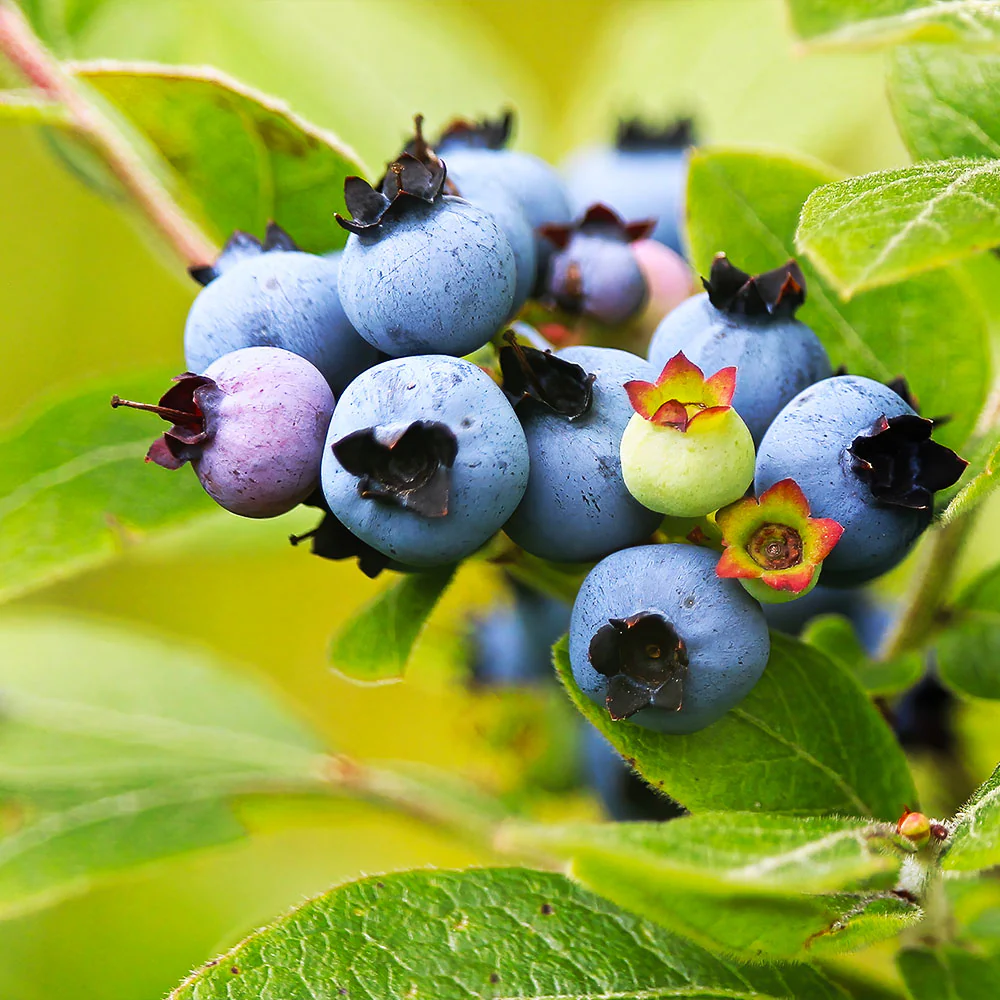 The blueberry, a member of the genus Vaccinium, is one of the few fruits native to North America. Long before it became a staple
in grocery stores and farmers markets, blueberries were an important food source for
Indigenous peoples and grew wild across forests and bogs throughout the continent.
The blueberry, a member of the genus Vaccinium, is one of the few fruits native to North America. Long before it became a staple
in grocery stores and farmers markets, blueberries were an important food source for
Indigenous peoples and grew wild across forests and bogs throughout the continent.
Today, blueberries are enjoyed around the world, but their story begins in the landscapes
and traditions of North America.
For centuries, Native Americans gathered blueberries from forests and bogs, consuming them fresh and preserving them for later use. Many tribes in the Northeast held blueberries in high regard, and a rich body of folklore developed around them.
At the blossom end of each berry, the calyx forms a perfect five-pointed star. Tribal elders told stories that the Great Spirit sent these “star berries” to relieve the children’s hunger during times of famine.
Different parts of the blueberry plant were also used medicinally. Tea made from the leaves was believed to improve the blood, while blueberry juice was used to treat coughs. The juice also served as a natural dye for baskets and cloth.
In cooking, dried blueberries were added to soups, stews, and meats. The berries were sometimes crushed into a powder and rubbed into meat for flavor. Blueberries were also included in a preserved meat dish called pemmican, made from dried blueberries and meat and eaten year-round.
Learn more about blueberries in Native American Traditional Indigenous Food Systems:
Prior to the early twentieth century, blueberries were not the common cultivated fruit we know today. They have only been commercially cultivated for about the past 100 years. Before that time, blueberries sold in U.S. markets were harvested almost entirely from the wild, which limited their distribution.
By comparison, apples have been cultivated for thousands of years. Their parent species, Malus sieversii, originated in Central Asia, a region with a long history of permanent human settlement dating back roughly 100,000 years.
Blueberries, however, are native to North America. Most evidence suggests that humans first arrived on the continent about 15,000 years ago, though some recent research points to even earlier inhabitants.
One early chronicler of American natural history was Englishman John Josselyn, who carefully observed the people and plants of northern New England during the seventeenth century. Josselyn was particularly interested in medicinal plants.
He wrote about “bill berries,” the European relatives of blueberries, noting that they were used:
“To cool the heat of Feavers, and quench Thirst… very good to allay the burning heat of Feavers.”
Josselyn also described how Native Americans prepared blueberries:
“They usually eat of them put into a bason, with milk, and sweetened a little more with sugar and spice… The Indians dry them in the sun, and sell them to the English by the bushell.”
The dried berries were used in puddings, boiled dishes, baked foods, and gruels.
Another simple dish favored by Native Americans was sautauthig, a mixture of dried blueberries and cracked corn combined with water. Historians believe that similar foods may have been served during the earliest Thanksgiving feasts in New England. Colonists often added milk, butter, or sugar when available.
Recipe for Sautauthig:
 French explorer Samuel de Champlain recorded one of the earliest accounts of blueberries in 1615, noting that Algonquin
people harvested and dried the abundant berries for winter use.
French explorer Samuel de Champlain recorded one of the earliest accounts of blueberries in 1615, noting that Algonquin
people harvested and dried the abundant berries for winter use.
Jesuit missionary Paul Le Jeune later wrote about the foods eaten by Indigenous peoples along the St. Lawrence River, mentioning raspberries, strawberries, blueberries, hazelnuts, and small wild apples. He even recorded that some believed paradise to be a place “abounding in blueberries.”
The native lowbush blueberry (Vaccinium angustifolium) grows wild throughout northeastern North America. These plants spread across well-drained, highly acidic soils and usually grow only about a foot tall.
Large areas known as blueberry barrens—rolling sandy landscapes often near foggy coastlines—were originally formed naturally and later maintained through Native American land management practices.
The berries produced in these rugged environments are small, sweet, and flavorful. Many people believe they are superior to the larger cultivated blueberries commonly found in stores today.
Blueberries belong to the genus Vaccinium, which includes more than 35 species native to North America. Worldwide, the genus contains many species adapted to a wide range of climates.
Some species grow in warm regions such as southern Mexico, while others are found throughout Canada and Alaska. Many cultivated blueberries today originate from the southern highbush blueberry (Vaccinium corymbosum), native to the eastern and southeastern United States and parts of eastern Canada.
Although the first successfully cultivated blueberry crop was not produced until 1912, blueberries had been an important food source for Native Americans for thousands of years.
Because blueberries store well when dried, they became an important winter food. They were eaten fresh in season and incorporated into soups, stews, and other traditional foods.
Native Americans also used various parts of the plant—roots, stems, leaves, flowers, and fruit—for medicinal purposes.
In many ways, Indigenous knowledge helped shape modern blueberry cultivation. Early European settlers learned about edible uses of the berries, their growth patterns, and where the plants thrived from Native American communities.
Modern commercial blueberry cultivation began with an unlikely partnership.
In the late 1890s, Elizabeth White, the daughter of a New Jersey cranberry farmer, became interested in the blueberry’s potential as a cultivated crop. At the time, most growers believed blueberries could not be domesticated because their growing requirements were poorly understood.
Around the same time, USDA botanist Frank Coville began studying North American blueberry species with the goal of developing improved cultivated varieties.
Coville had previously served as a field botanist on the first comprehensive scientific expedition to Death Valley in the early 1890s. He later became chief botanist for the U.S. Department of Agriculture and published more than 170 scientific papers and books.
In 1911, Coville published “Experiments in Blueberry Culture,” documenting research on cultivating Vaccinium species. His key discovery was that blueberries require highly acidic soil, something growers had not previously understood.
After reading Coville’s book, Elizabeth White contacted him and offered land on her family’s cranberry farm for research. Their collaboration laid the foundation for modern blueberry cultivation.
Blueberry production expanded dramatically in the late 1990s and early 2000s when scientific studies highlighted the fruit’s health benefits, identifying blueberries as a nutritional “superfood.”
As demand increased, U.S. production grew from roughly 100 million pounds annually in the late 1990s to more than 500 million pounds today.
The next time you enjoy these small blue berries, remember their long history—from Indigenous harvesting and knowledge to scientific innovation that made them widely available.
Blueberries in Modern North Carolina Agriculture
In North Carolina today, blueberries are big business, ranking sixth in the nation for blueberry production. From the coast to the mountains, there are different landscapes that have proven well-suited for growing this sweet, delicious crop. We even have a U-Pick blueberry farm right here in the Sandhills!
The fruit was officially recognized as one of the state’s berries after North Carolina schoolchildren campaigned for a state berry designation. In 2001, the General Assembly compromised by naming a blue berry (blueberry) and a red berry (strawberry).
According to the North Carolina State University Extension Service, the state produces roughly 40 million pounds of blueberries each year, valued at approximately $70 million.
The annual blueberry harvest occurs mainly during June and July. Although blueberries are native to North America, they were not planted commercially in North Carolina until 1936.
Blueberries are sweet, rich in fiber and vitamin C, and contain high levels of antioxidants. Because of their many health benefits, they are often referred to as a “superfruit.”
From forests and bogs where Indigenous communities first gathered them to farms across North Carolina today, blueberries remain deeply connected to the landscapes and traditions of North America.
Learn more about local NC Blueberries
Want to pick your own? Check out Blueberry Hill in Sanford.
Sources:
History of Blueberries - Blueberry.org
Native Fruit: The Wild Blueberry – Smithsonian Libraries and Archives / Unbound